
5 Signs Your Garage Door Spring Is About to Break (Before It Snaps)
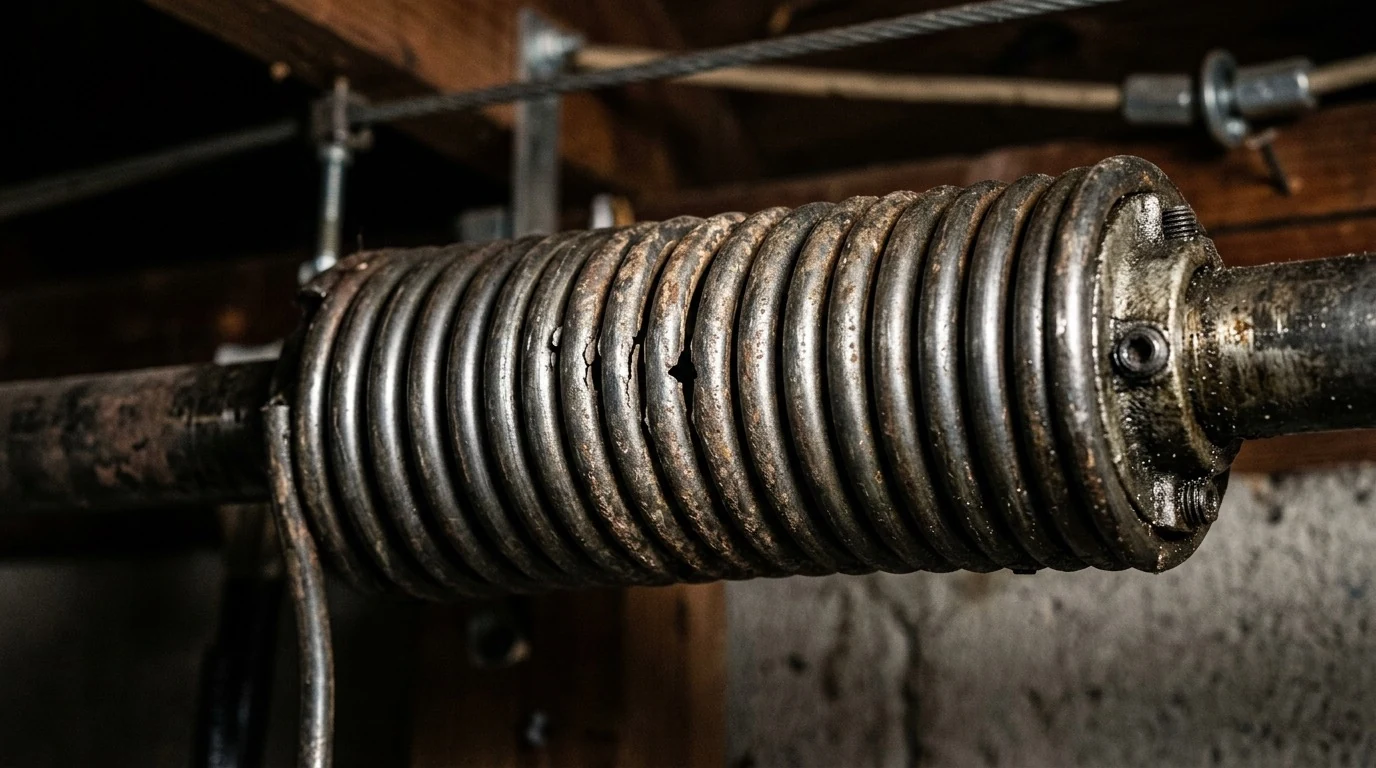
A garage door spring doesn't fail all at once in most cases. It gives you warnings — subtle changes in how the door moves, sounds it makes, and things you notice if you're paying attention. The problem is that most homeowners aren't watching for them.
Here are the five signs that your spring is reaching the end of its life — and what to do when you notice them.
1. The Door Feels Unusually Heavy When You Lift It Manually
This is the most reliable early warning sign, and it requires about 30 seconds to check.
Disconnect your garage door opener by pulling the red release cord hanging from the trolley. Then try to lift the door by hand from its fully closed position. A properly functioning door with a healthy spring should feel light — 10 pounds or less of lifting effort. The spring is supposed to counterbalance most of the door's weight (which can be 150–400 lbs for a steel double-car door).
If the door feels noticeably heavy — if you're straining to lift it or it feels like you're lifting 40–60 lbs — the spring has lost significant tension. This is a sign that it's losing its ability to counterbalance the door's weight. It's still functioning, but it's in decline.
What to do: Schedule a spring inspection. This is not yet an emergency, but it should be addressed within a few weeks before the situation escalates.
2. The Opener Is Working Harder Than It Used to
This is harder to notice because it happens gradually, but there are two ways to detect it:
Sound change: If your opener motor sounds like it's laboring — a louder hum, a longer cycle time before the door starts moving — the spring isn't sharing the load the way it should. The opener is a motor designed to manage a few pounds of final mechanical advantage, not to lift a 200-lb door on its own.
Response change: If the door hesitates before starting to move when you press the button, or if it moves more slowly than it used to, that's often the opener struggling against a door that's heavier than the spring is supposed to make it.
In Gadsden: Alabama's humidity can also cause openers to struggle on very humid days. But if the sluggishness is consistent rather than weather-correlated, it's more likely a spring issue.
What to do: Check the spring visually (step 5 below) and schedule an inspection. Continuing to run an opener against a failing spring can burn out the motor — turning a $200 spring replacement into a $200 spring + $300 opener repair.
3. The Door Doesn't Open Evenly
Stand back and watch your door open from directly in front of it. In a properly functioning system, both sides of the door rise together at the same rate. The top corners move together. The door stays horizontal as it travels upward.
If one corner rises faster than the other — if the door looks like it's twisting or climbing on a diagonal — you likely have a spring issue on one side. This is more common with extension spring systems (the springs on the sides of the door) where two separate springs work independently. If one is failing while the other isn't, they pull the door unevenly.
On torsion spring systems (the single bar above the door), uneven travel can indicate a spring that's losing tension on one side of the coil, or an improperly tensioned spring after a previous replacement.
What to do: Stop using the door if the unevenness is severe — an unevenly loaded door puts asymmetric stress on the track and rollers. Call us at (256) 792-0501 for an inspection.
4. You Hear Squeaking or Creaking During Operation
A garage door that was previously quiet but has become squeaky is telling you something — usually that lubrication has dried out or that components are wearing unevenly.
Spring squeak specifically: when a torsion spring loses its lubricant coating, the coils rub against each other during the winding and unwinding process. The friction produces a distinctive squeak or creak that tracks with the door's movement. In Gadsden's humid climate, lubricant evaporates faster and is often washed away by condensation — which is why we see dry springs more frequently here than in drier climates.
A squeaky spring isn't an immediate emergency, but a dry spring corrodes faster, develops friction wear at the coil surfaces, and will fail sooner than a properly lubricated one.
What to do: Apply a silicone spray or white lithium grease to the full length of the spring. If the squeaking returns within a few weeks, the coil surfaces may already be roughened from corrosion — have it inspected.
5. You Can See a Visible Gap in the Spring Coil
This one's straightforward: if there's a gap in the tightly wound coil of your torsion spring — a section where the coils have separated — the spring is broken. It doesn't matter whether it happened with a bang or silently overnight. A broken torsion spring is a broken torsion spring.
Stop operating the door immediately. Don't try to open or close it. A door without a functioning spring puts the full weight on the opener motor and creates a risk of the door falling suddenly.
Call us at (256) 792-0501. This is an emergency repair — we handle spring replacements 24 hours a day in Gadsden and surrounding Etowah County communities.
The bottom line: Signs 1–4 are caught during a tune-up. Sign 5 is a phone call. Annual maintenance is how you stay in the first category. If your Gadsden-area door hasn't been professionally inspected in the last year — especially if the hardware is more than 7 years old — it's worth scheduling a visit before you discover the problem on a Monday morning when you need to be somewhere. Call (256) 792-0501.
Need Help Right Now?
We answer every call — 24 hours a day, 7 days a week. No voicemail, no waiting.