
The Complete Garage Door Maintenance Checklist for Gadsden, AL Homeowners
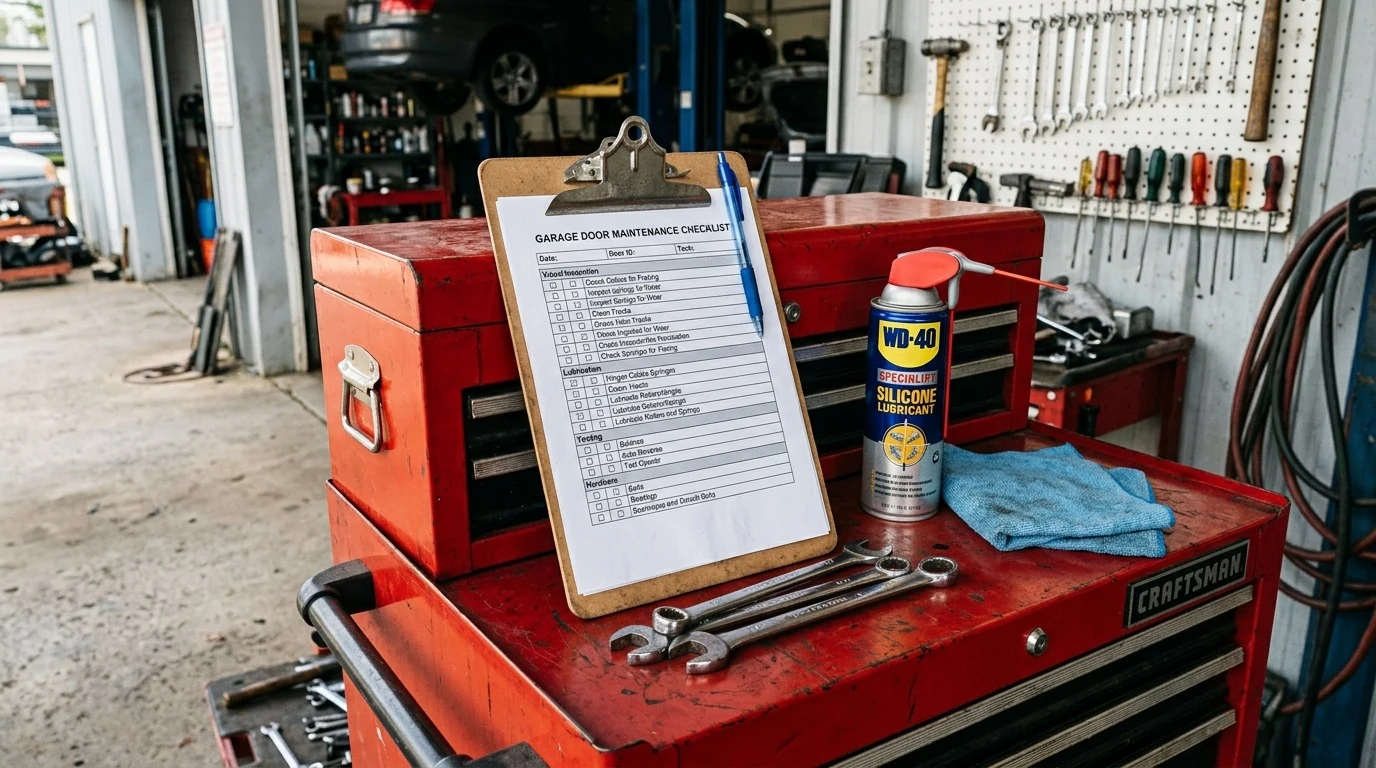
A garage door operates 3–5 times a day in most households — that's over 1,000 cycles a year. At that rate, it's one of the most frequently used mechanical systems in your home. Like any mechanical system, it lasts longer and costs less to maintain than to repair when it's given consistent attention.
In Gadsden's climate specifically, the standard national maintenance advice under-accounts for what humidity, temperature cycling, and seasonal Alabama weather does to garage door hardware. Here's a complete maintenance schedule calibrated for Etowah County conditions.
Monthly: Quick Visual Checks (5 Minutes)
Once a month, take a slow walk around the door while it opens and closes. You're looking and listening for anything that's changed from the baseline of a smoothly operating door.
- Watch the door travel. Does it open and close evenly, with both sides rising together? Any hesitation, jerking, or diagonal movement?
- Listen for new noises. Grinding, squeaking, popping, or rattling that wasn't there last month is information. Note it and investigate.
- Check the auto-reverse. Place a 2x4 flat on the ground in the door's path and close it. The door should reverse immediately upon contact. If it doesn't, the force settings need adjustment — this is a safety function. Test this monthly.
- Check the photo-eye sensors. Wave your foot through the path of the sensor beam while the door is closing. The door should stop and reverse immediately. Both sensor indicator lights should be solid (not blinking) at all times.
Every 6 Months: Lubrication (March and September)
The national standard advice is to lubricate garage door components annually. In Gadsden's climate — 70–75% average humidity, significant condensation cycling in winter — we recommend twice a year. Do it in March before summer heat peaks and again in September before winter condensation season.
What to use: White lithium grease or silicone spray formulated for garage doors. Do not use WD-40 (it's a solvent) or general-purpose lubricating oil (too thin, runs off quickly).
What to lubricate:
- Torsion spring: Spray or wipe the full length of the spring. The lubricant creates a barrier between the steel and humid air, slowing corrosion and reducing friction between coils.
- Hinges: Each hinge on the door — the pivot plates that connect sections. Apply lubricant to the pivot point and the area where the roller stem passes through the hinge.
- Roller stems: Where the steel stem inserts into the hinge. Do not lubricate the nylon wheel of the roller itself; just the stem.
- Top of the curved track: Apply a small amount to the curved section of the track where the rollers transition from vertical travel to horizontal. Keep lubricant off the vertical (straight) sections of track — the rollers need grip there.
- Lock mechanism: If your door has a keyed exterior lock, apply a small amount of lubricant to the lock cylinder and the bolt mechanism.
- Opener rail: If you have a chain-drive opener, apply light lubrication to the chain. Belt-drive openers do not require lubrication on the belt.
What NOT to lubricate: The vertical section of the tracks (where the rollers need to grip), the bottom weatherstripping, or any component that friction is supposed to work against.
Every 6 Months: Balance Test
This takes 30 seconds and tells you a lot about your spring's health.
Pull the red emergency release cord to disconnect the door from the opener. Manually lift the door to about waist height and let go. A properly balanced door should stay in place — it should neither drift down nor float up. It may settle an inch or two but should stay roughly where you left it.
A door that immediately falls when you let go has a weak spring (too little tension). A door that floats upward has too much spring tension. Either is a condition that needs a technician to evaluate — the spring tension is what a tech adjusts during a tune-up.
Annually: Hardware Inspection and Tightening
Once a year — fall is a natural time, before the system gets the extra stress of winter cold — go through the door hardware systematically:
- Tighten all hardware. Use a socket wrench to snug the bolts on track brackets, hinges, and roller brackets. Vibration works these loose over hundreds of cycles. Don't overtighten — just firm.
- Inspect rollers. Steel rollers should spin freely with no visible flat spots or rust buildup. Nylon rollers should have no cracks in the wheel. If rollers are rough, worn, or cracked, they need replacement — worn rollers are a grinding noise waiting to happen.
- Inspect cables. Look at the cable running from the bottom corner of the door up to the drum. Cables should be smooth, fully intact, and properly seated in the drum groove. Any fraying, kinking, or rust along the cable is grounds for replacement.
- Inspect the spring. Look for rust discoloration or gaps in the coil. A gap anywhere in the tightly wound coil means the spring has broken, even if it happened gradually. Visible rust is a warning to lubricate and schedule an inspection.
- Check weatherstripping. Inspect all four sides. The bottom seal should be soft and pliable, making full contact with the floor. Side and top seals should be intact and making contact with the door edge. Replace anything that's cracked, torn, or compressed flat.
- Test the opener's safety features. Beyond the monthly auto-reverse test, check the wall button's "hold-to-close" function if it has one, verify that the outside keypad code is still programmed, and check the battery in your remotes.
Every 7 Years: Professional Service Evaluation
Standard springs are rated for 10,000 cycles — roughly 7 years at typical household usage. As a door approaches this milestone, a professional evaluation makes sense even if nothing has failed yet. A tech can assess spring condition, cable condition, and overall hardware wear and give you an honest timeline for what needs attention. Proactive spring replacement on a door approaching the 7–10 year mark is significantly less disruptive (and less expensive) than an emergency spring replacement when it snaps.
When to Call Instead of DIY
Everything above is within homeowner territory for someone who's reasonably handy. The line is drawn at springs and cables — those components store significant mechanical energy and need professional attention for adjustment, repair, or replacement.
If your annual inspection reveals a spring with a gap, frayed cables, or rollers so worn that the door is grinding on every cycle, that's a service call. We offer a comprehensive maintenance visit in Gadsden that covers all of the above inspection points, lubrication, balance check, and hardware tightening — call (256) 792-0501 to schedule.
Need Help Right Now?
We answer every call — 24 hours a day, 7 days a week. No voicemail, no waiting.