
What You Can DIY on Your Garage Door (And What You Definitely Should Not)
We work on garage doors every day, and we genuinely appreciate a homeowner who pays attention to their system and handles the tasks they can handle themselves. It makes our job easier when the door hasn't been neglected for years, and it saves you money on service calls for things that don't require a tech.
So here's an honest breakdown — from people who make their living doing this — of what's safe to DIY and what isn't.
DIY-Safe: Things You Can and Should Do Yourself
Lubrication
This is the single most valuable maintenance task, and it's entirely safe to do yourself. Every six months (spring and fall), apply a silicone spray or white lithium grease to:
- The full length of the torsion spring (the bar above the door)
- Every hinge — the small pivot plates connecting the door sections
- Each roller stem — where the stem inserts into the hinge
- The top of the door track, where the rollers contact the rail
- The lock mechanism if you have a keyed lock on the door
Don't lubricate the track itself below the curve — that section should stay clean so the door doesn't slide when you want it to stop. And don't use WD-40; it's a solvent and will actually remove the protective coating you're trying to create.
Sensor Realignment
If your door won't close and the opener is blinking, the safety sensors are usually the culprit. Each sensor has a small indicator light that should be solid (not blinking) when properly aimed. If one is blinking, loosen the mounting wing nut and gently adjust the sensor's angle until both lights go solid, then re-tighten. This is a two-minute job.
Replacing the Battery in Your Remote or Keypad
Self-explanatory, but we mention it because we do occasionally get calls from people who've been pushing their remotes increasingly hard for weeks before thinking to check the battery.
Cleaning Tracks
Use a rag to wipe debris from the inside of the tracks — especially the lower vertical sections where leaves, mud, and grime accumulate. A clean track reduces roller wear. Just don't spray anything into the track that will leave a sticky residue.
Tightening Loose Hardware
The hardware on a garage door vibrates with every cycle. Nuts and bolts do work loose over time. You can safely tighten the bolts holding the track brackets to the wall, the fasteners on the hinges, and the bolts securing the roller brackets. Use a socket wrench or nut driver — don't overtighten, just snug. Do not loosen or adjust the bolts holding the cables to the bottom corners of the door without understanding cable tension mechanics first.
Replacing Weatherstripping
The bottom seal (the rubber strip along the bottom edge of the door) is designed to be replaceable. You can buy replacement bottom seals at any hardware store — they slide into a retainer track on the door bottom or nail/staple in place, depending on the type. Side and top weatherstripping is similarly replaceable. This is a legitimate DIY project that can improve both energy performance and pest control.
Do NOT DIY: Things That Can Seriously Hurt You
Torsion Spring Replacement or Adjustment
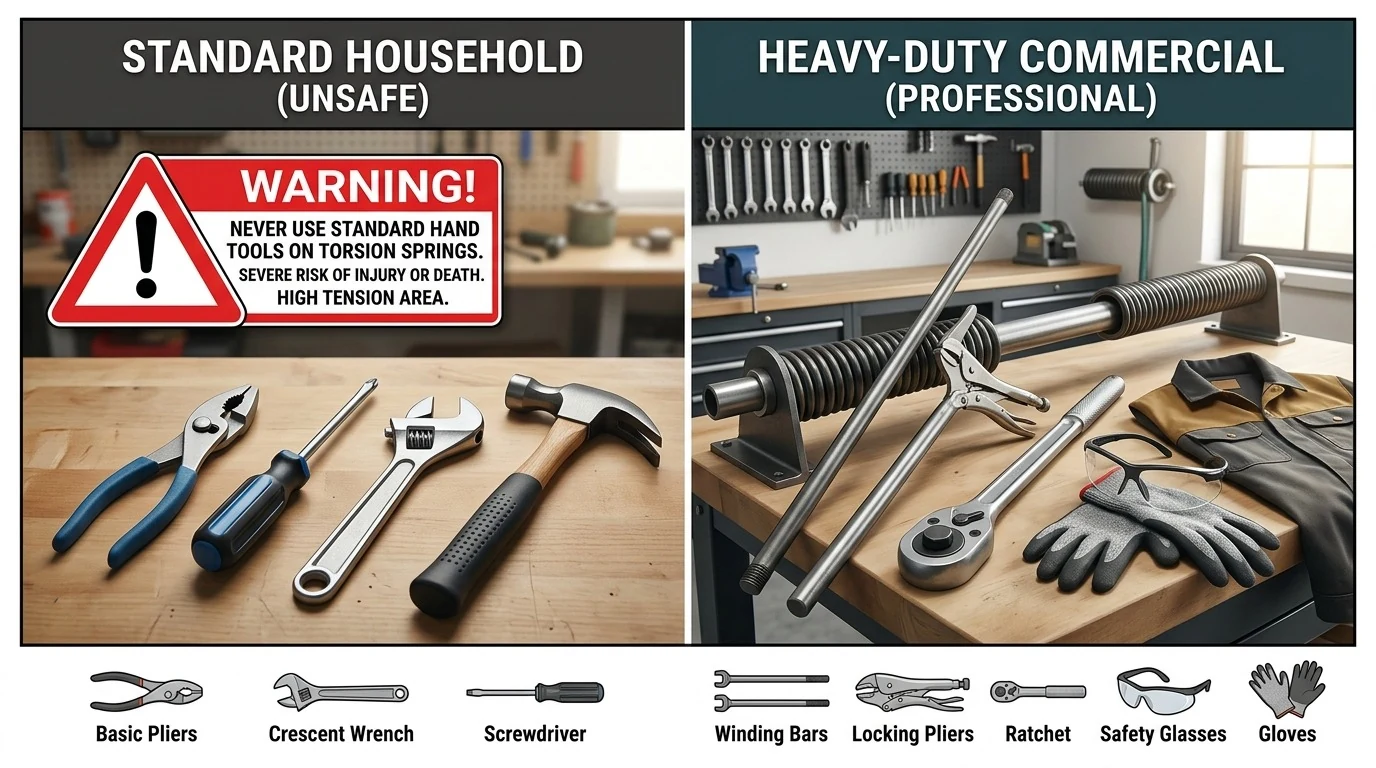
This is the one we want you to read carefully. Torsion springs — the horizontal bar above your door — store an enormous amount of mechanical energy. A standard torsion spring for a double-car door is wound under hundreds of foot-pounds of torque. When it snaps or releases incorrectly, that energy goes somewhere. We have seen the damage that a loose torsion spring can do to tools, walls, cars, and people. It is not worth the risk.
Spring replacement requires specific winding bars (not screwdrivers, not pipe), knowledge of the correct number of turns for your specific spring size and door weight, and experience with what happens when things go wrong. The cost of professional spring replacement in Gadsden ($150–$350) is genuinely cheap relative to an emergency room visit.
Cable Replacement
Lift cables are under tension from the springs. Releasing that tension incorrectly can cause the spring to unwind violently or the door to drop suddenly. Cables also need to be correctly wound onto the cable drums at specific angles and tension levels. This is a job for a tech.
Adjusting Spring Tension
If your door is unbalanced — one side heavy, the other light — the spring tension needs adjustment. This is what the winding bars are for. Every quarter-turn of a winding bar represents significant stored energy. Without training and experience, this is genuinely dangerous.
Replacing the Trolley Carriage or Drive System
The trolley carriage (the part that rides along the opener rail and connects to the door) can fail over time. Replacement involves disconnecting and reconnecting the door to the opener, managing cable and spring tension, and ensuring everything is properly aligned before first operation. A misaligned reconnection can cause the door to bind, jump the track, or create a cable failure. Have a tech do it.
The Rule of Thumb
If the task involves touching, adjusting, replacing, or going near the springs or cables — get a professional. Everything else on the door, with a basic understanding of how the system works, is generally within homeowner territory.
Have a repair that you're not sure falls into which category? Call us at (256) 792-0501 and describe what you're seeing. We're happy to tell you over the phone whether it's something you can handle or whether it needs a tech — and we'll never pressure you to schedule a call just to have the conversation.
Need Help Right Now?
We answer every call — 24 hours a day, 7 days a week. No voicemail, no waiting.